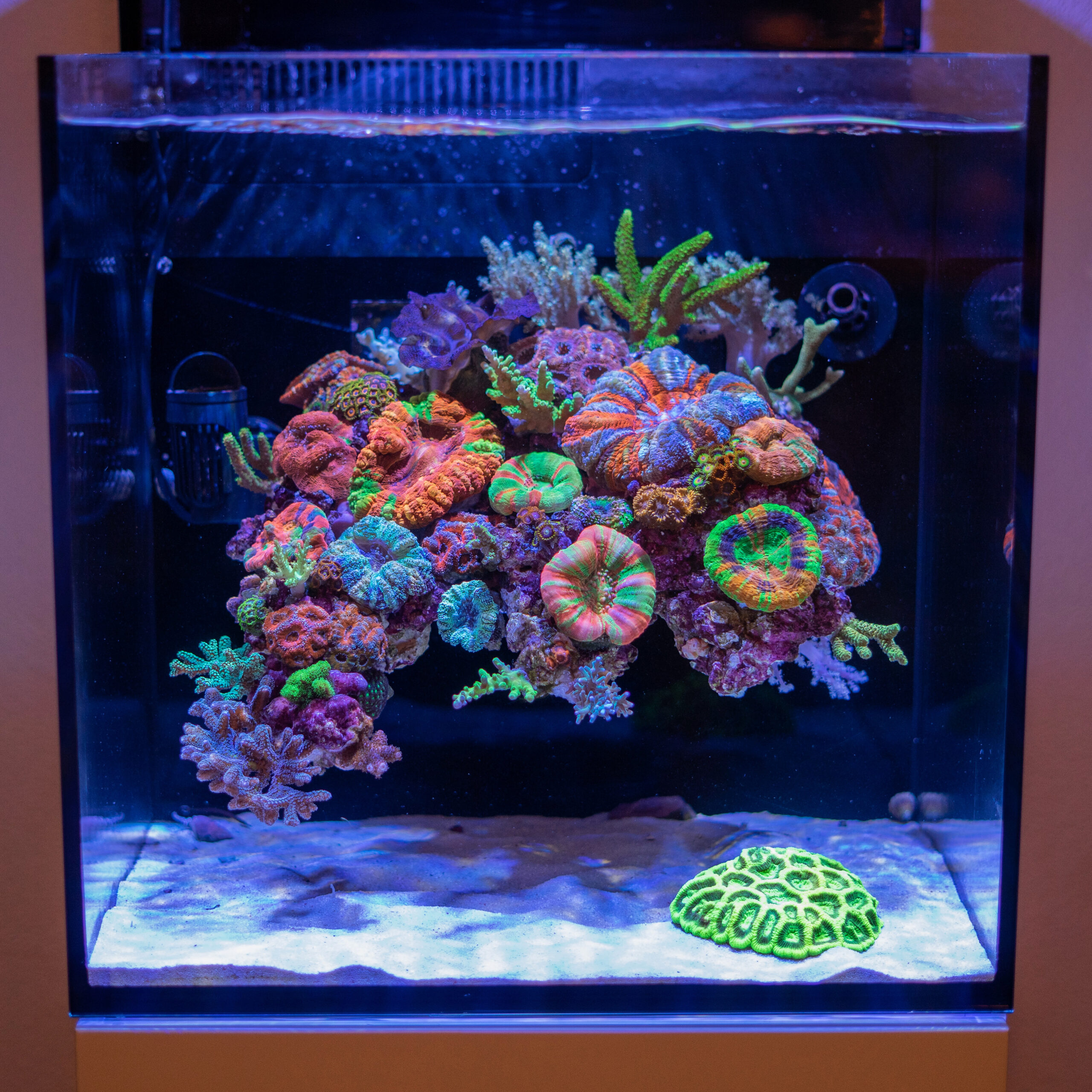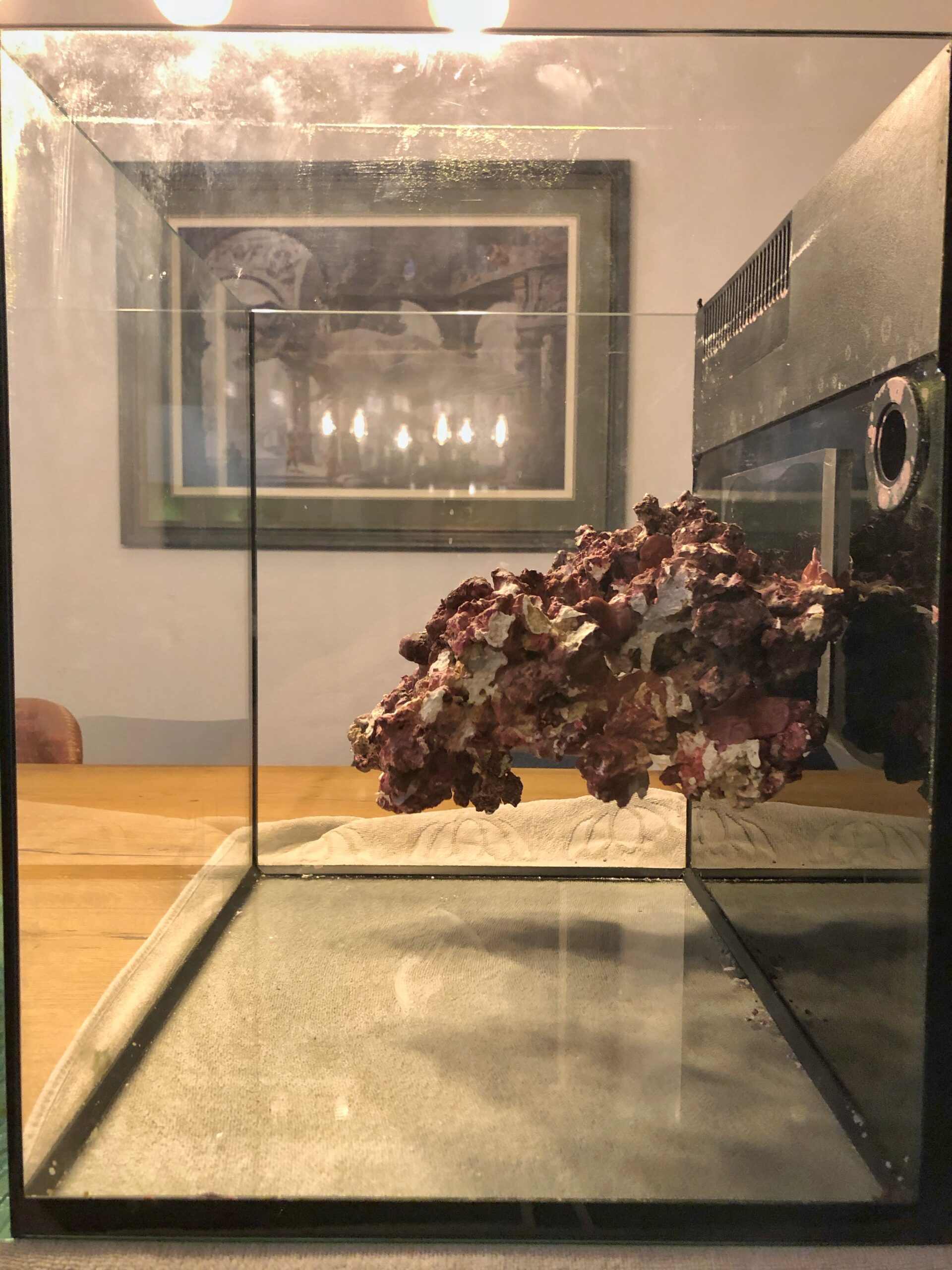
Earlier this year, we showed you a fantastic aquarium that’s been very popular on social media. Today, we’re sharing the story behind the latest reef set up by the same aquarist. This is the latest tank by Dave Notter (31) from Bern, Switzerland—the man behind the floating reef.
The floating reef is an incredibly popular aquarium. In March 2020, Reefkeepingtoday also published the definitive guide to building your own floating reef. Today, we’re pleased to show you Dave Notter’s latest aquarium. It looks quite different.
While the floating reef was relatively extravagant, with countless corals in a well-stocked Red Sea MAX Nano, this new coral reef is more minimalist in style. That doesn’t mean, however, that there are fewer corals; it simply means that the aquarium has gotten larger.
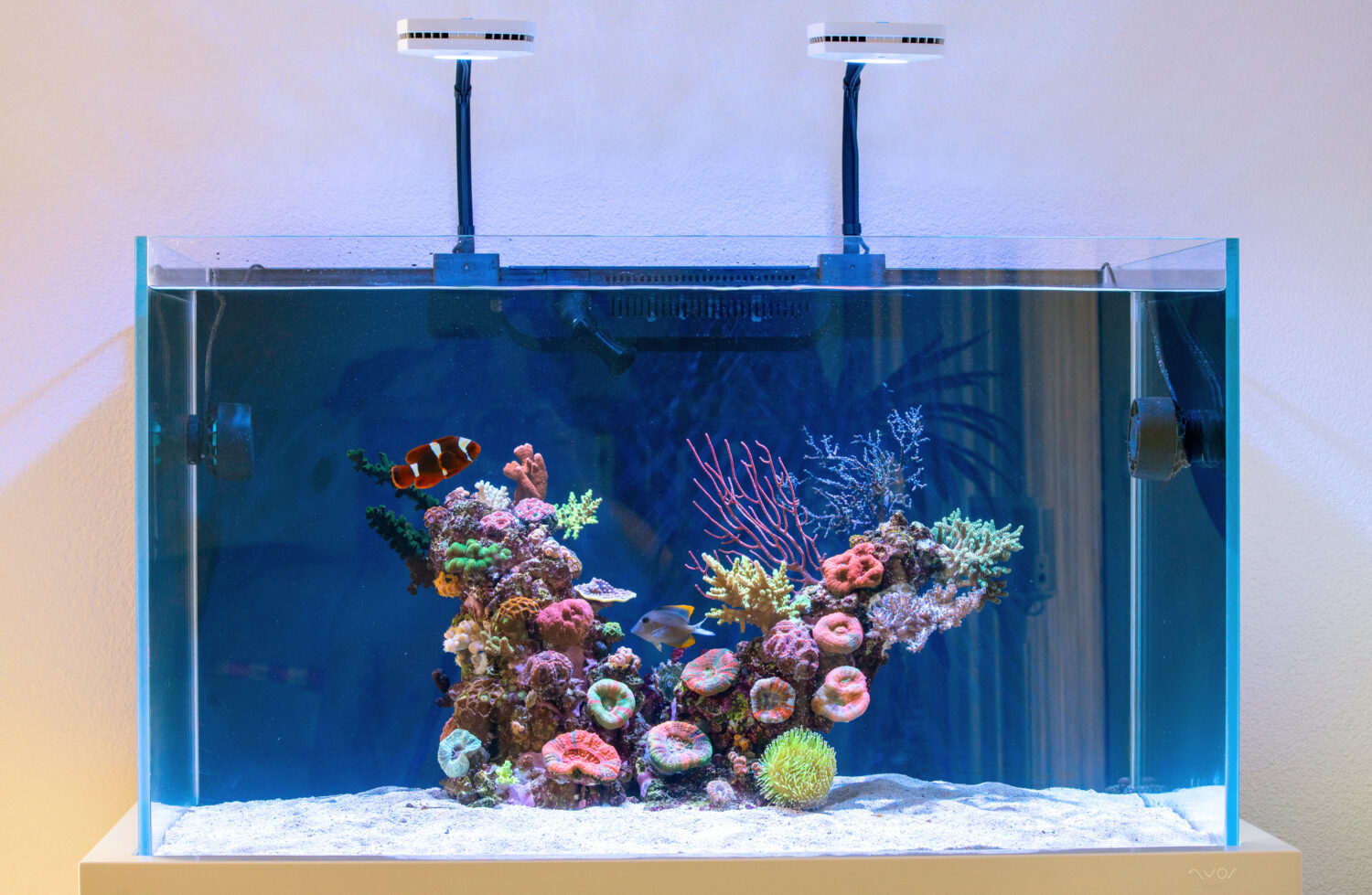
Notter chose a Nyos Opus 300 aquarium. It has a volume of 262 liters and measures 90 x 55 x 53 cm. “In the new apartment,” Notter explains, “I wanted a really suitable aquarium that would bring a lot of visual elegance and simplicity to the space. It fits almost perfectly with the other furniture in the apartment.”

New Scape
A new aquarium naturally means a new aquascape. Notter opted for a different approach. “From the start, I knew it wouldn’t be a traditional scape. It had to be very simple again, with just one focal point.” The aquarium was set up in June 2020, and it took just seven days before it was fully stocked—corals and fish included.
“The idea behind the aquarium was that it should be a simple setup. It is, therefore, a very minimalist layout that allows the viewer to see at a glance what it’s all about.” The layout consists of two small towers arranged in a V-shape, covered abundantly with corals. “They’re little islands of life,” says Notter.
The aquascape was first built outside the aquarium: “I used wood to replicate the dimensions of the aquarium, so I could measure my aquascape perfectly to match the aquarium’s proportions. I created the rockwork using some Real Reef rocks and PAM glue. It was just a matter of stacking and gluing, which went very well.”

Living Pallet
All the corals from the floating reef were placed in the new aquarium. “The layout was very harmonious, and no new corals were needed,” says Notter. Still, he couldn’t help himself: “That’s just how it is. You buy new corals, and then you have to rethink the layout.” At first, I wanted to add more Acropora, which I did. And then I was able to buy Azoox corals (non-photosynthetic corals, ed.), and they were so fascinating that I wanted more. So I sold some of the Acropora and Scolymia… Of course, I kept most of the Scolymia.”
According to Notter, the scape is never quite finished, but with six Scolymia, three Acropora, one Montipora digitata, two Seriatopora, four soft corals, one gorgonian, four Tubastrea, one Dendrophyllia, one Turbinaria, and thirteen species of Zoanthus, there’s certainly no shortage of variety.
There are also one Chromis retrofasciata, one Manonichthys splendens, one Ctenochaetus tominiensis, two Synchiropus picturatus, and two Doryrhamphus excisus swimming around. Various snails, one Percnon gibbesi, two Stenopus cyanoscelis, and two Lysmata kuekenthali round out the list.

Technology
Of course, all that life needs to be maintained. The included sump was modified to meet Notter’s needs. He removed a few components to make room for a Clarisea SK3000 roller mat filter. An electric ATO was installed, along with activated carbon and a Nyos Quantum 120 skimmer. A UPS provides extra protection during power outages.
To ensure optimal coral growth, Notter chose two AI Prime 16HD LED fixtures. Two Nero 5 flow pumps were also purchased, along with a Tunze Silence sump pump. The ATO is an Aqua Medic Refill System Pro. The thermostat is also from Aqua Medic—a Titanium Heater 100W. Two Reef Factory dosing pumps add trace elements, though Notter does not use a specific system. On hot days, the GHL Propeller Breeze kicks in.
Every two weeks, Notter also changes 60 liters of water. “That’s the most important rule,” Notter says. “Beyond that, stability is key—without getting lost in constantly testing water parameters. Just observing the corals can tell you a lot.”