Those who have installed an Automatic Water Top-Off (ATO) system know it well. It’s a relief to no longer have to manually top off the water. All you have to do is refill the RO reservoir every few days, and you’re all set. But what if we could automate that last step as well? Reefkeepingtoday is testing the AutoAqua Smart ATO RO—a device that automatically refills the reservoir.
Last month, we tested the AutoAqua Smart ATO Duo—basically the “regular” version of the device we’re testing today. It worked so well that it became a staple in our aquarium. Can this RO version do the same?
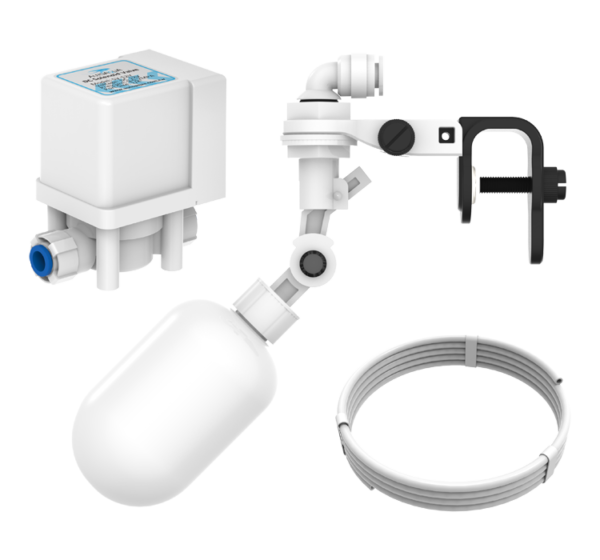
With the Smart ATO RO — distributed by Aquarioom — AutoAqua has upgraded the ATO Duo, which now has a slightly different function. This model comes with not one sensor, but two. The package also includes a float, a solenoid valve (a type of electronic valve that automatically shuts off the water when it receives a signal), and, of course, some tubing and the AutoAqua ATO control unit. With this kit, you can automatically refill the water reservoir so you’ll never have to turn your entire reverse osmosis system on or off manually again.
Lineup
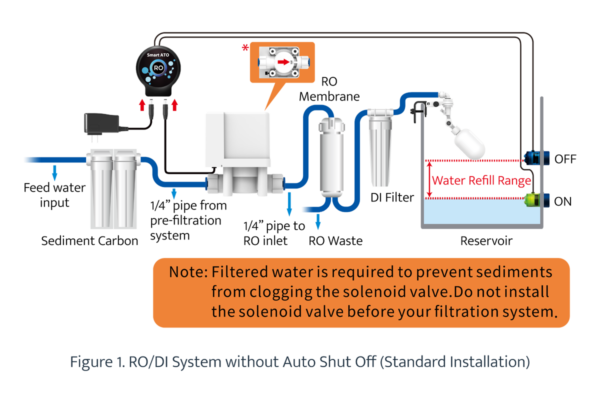
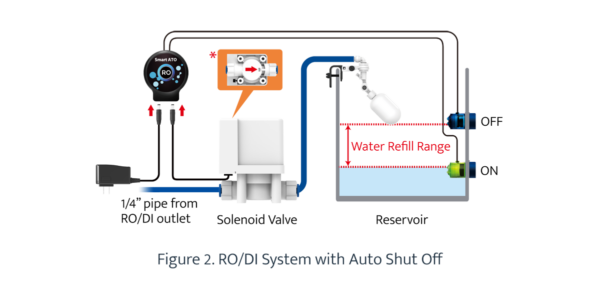
There are two ways to install the AutoAqua Smart ATO RO in the sump. If you have an RO/DI system without an automatic shut-off, you must install the AutoAqua solenoid valve between the carbon filter and the RO membrane. This prevents the membrane from being used constantly, which would naturally lead to premature degradation. If you’re lucky enough to have an RO/DI system with an automatic shut-off, you can simply install the solenoid valve at the outlet of the RO/DI system.
No sooner said than done. We connect the AutoAqua Smart ATO RO to the Glamorca RO1 and position our two sensors at the minimum and maximum levels in the RO reservoir. This means we haven’t replaced the traditional function of an ATO (the AutoAqua Smart ATO Duo is still installed on the aquarium), but we have automated the entire system.
Usage
Once everything is connected correctly—and to be honest, it does take a bit of know-how, since we have to make the right cut to connect the solenoid valve—everything goes smoothly. The system activates correctly when the water level is too low and the ATO pump is about to suck in air. The water from the RO/DI system also stops flowing automatically thanks to the solenoid valve, which is triggered by the highest sensor.
There is no maintenance required, other than a periodic check to ensure that all lines are still functioning properly. It is especially important that the solenoid valve be installed correctly—before the diaphragm but after the sediment filter. Otherwise, it may become clogged, causing problems with shutting off the water supply, which could lead to flooding.
Decision
With the Smart ATO RO, AutoAqua has made it possible to install the ultimate RO/DI system. On the one hand, there’s the separately available Smart ATO Duo, which is significantly easier to use thanks to its combination with the ATO RO. Topping off the water is now a thing of the past.
Of course—and this is perhaps the only limitation of the entire system—you need to have a RO/DI unit located near the aquarium. The cables have to be run all the way into the sump, which can be difficult for many people. However, this will remain the case with any similar system.
The AutoAqua Smart ATO RO is available for 140 EUR.