An osmolator is perhaps the most important piece of equipment for an aquarist. Without replenishing evaporated water, even the hardiest fish will eventually become too salty. Reefkeepingtoday tests the Smart ATO Duo from AutoAqua.
Stability in the aquarium is the greatest good. Any device that helps maintain the delicate balance of our indoor ecosystem is, in our view, a useful one. An Automatic Top Off (ATO) or osmolator is therefore one of the most important—if not the most important—devices an aquarist can purchase. OK, it’s possible to manually add a little water to the aquarium every day, but trust us, an ATO is so much better—if only because you don’t have to think about it anymore.
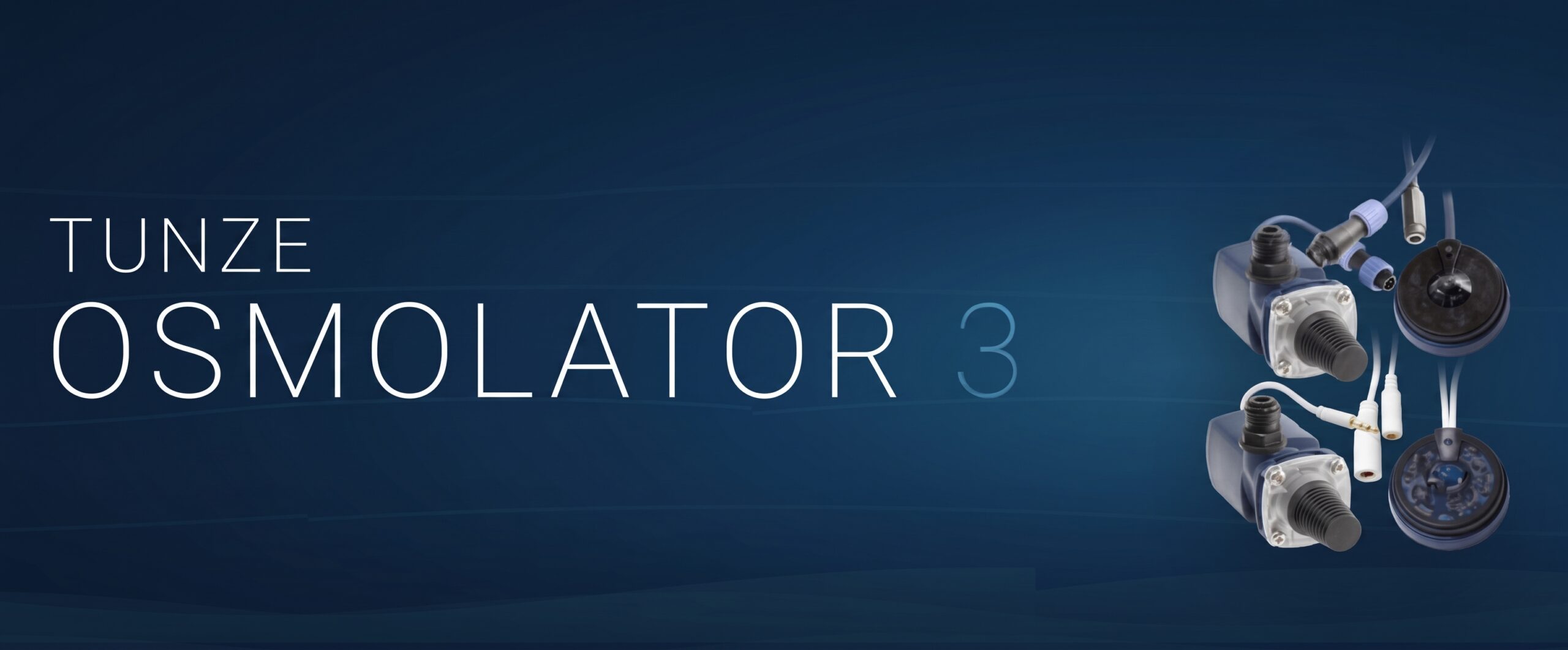
For years, we used a Tunze Osmolator—as, no doubt, have most hobbyists. Nothing wrong with that—quite the opposite. It’s exceptionally reliable and sturdy. However, we recently acquired an AutoAqua Smart ATO Duo (thanks, Aquarioom). Will it be able to take over the most important task in our aquarium? Read on to find out.
Lineup
With the Smart ATO Duo, AutoAqua has introduced a simple device to the market. The main difference from the Tunze Osmolator is that this ATO manages to fit the two sensors (primary and backup) into a single compact housing. As a result, the Smart ATO Duo takes up significantly less space. AutoAqua has also used two optical sensors, rather than one optical sensor and one float sensor like Tunze.
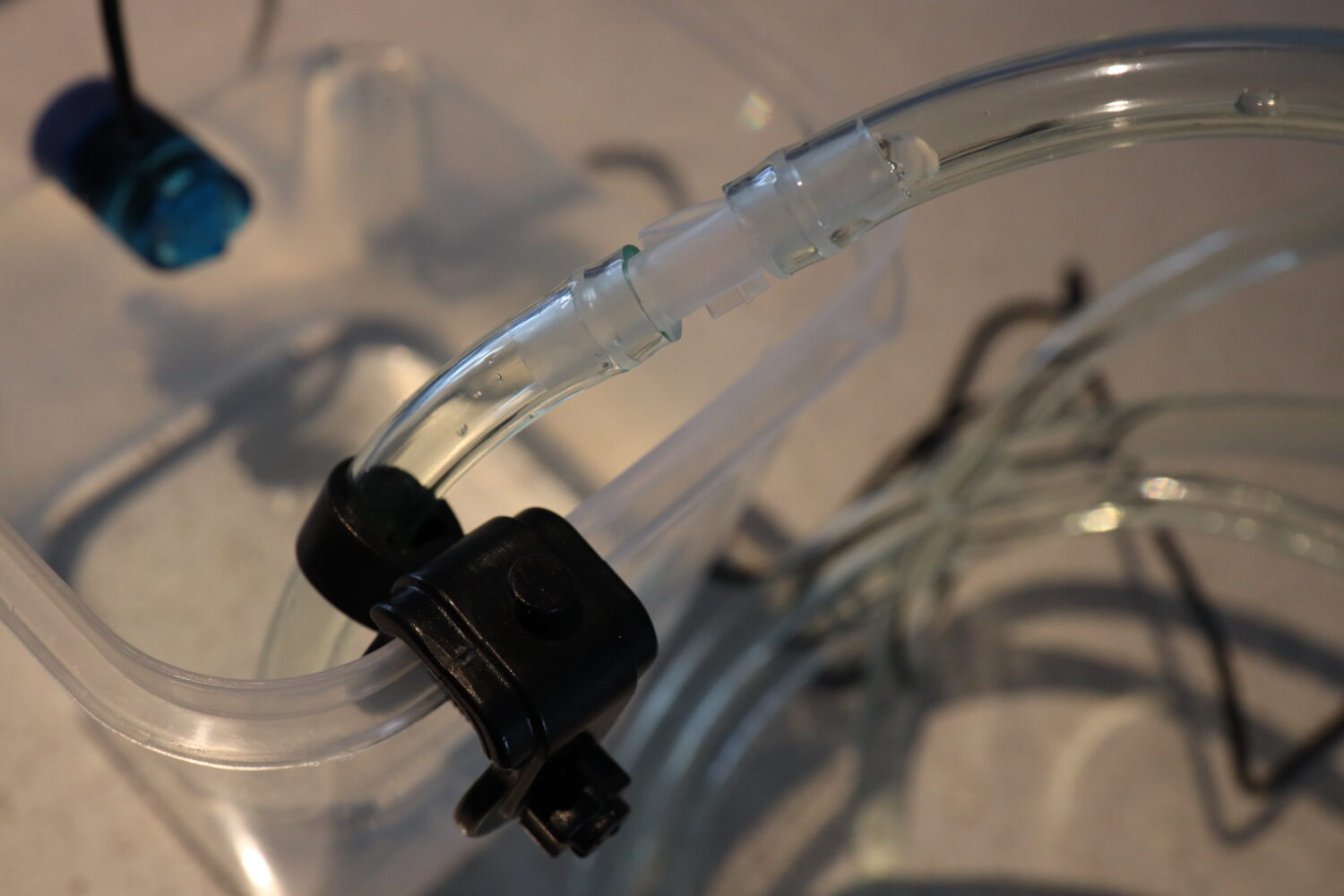
This makes setting up the AutoAqua Smart ATO Duo very easy. Just attach the small but strong magnet to the sump—we place it in the pump chamber—connect the cable from the included feed pump and the transformer, position the water hose properly along with the check valve, and voilà. It’s incredibly easy, with no headaches.

Usage
In our test setup, we tested four things: 1) the precision of the refill function, 2) the overflow protection, 3) the empty-tank protection, and 4) the noise level. In our opinion, these are the most important functions of an ATO, and the first three tests, in particular, must pass if we are to go on vacation with peace of mind.
We can be quite brief about the precision: the AutoAqua Smart ATO Duo refills perfectly up to the level of the first sensor. This sensor is located at the bottom, with the backup sensor above it. In repeated tests, we placed the sensor at various heights, after which the ATO neatly topped off the water to our set level. The overflow protection also works as it should. Although the ATO does not seem to issue a warning when the water level is too high.
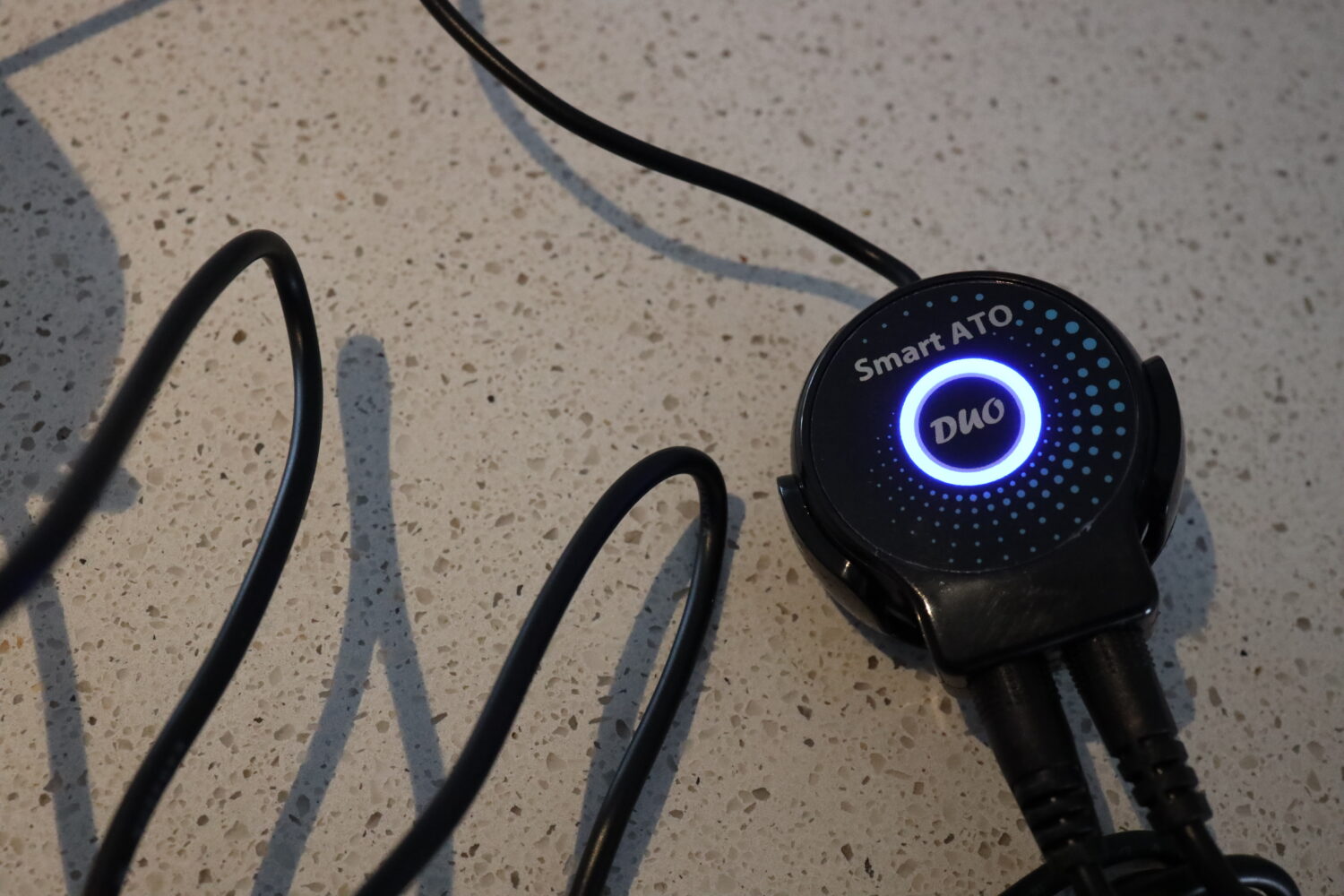
The question, of course, is how this level is reached; it’s often the result of an adjustment to the overflow pipes, causing a sudden, temporary increase in water in the sump. Is it necessary, then, to sound an (audible) alarm? The Smart ATO Duo only provides a visual signal indicating that the water level is OK. Naturally, the pump stops running when the sensor is completely submerged.
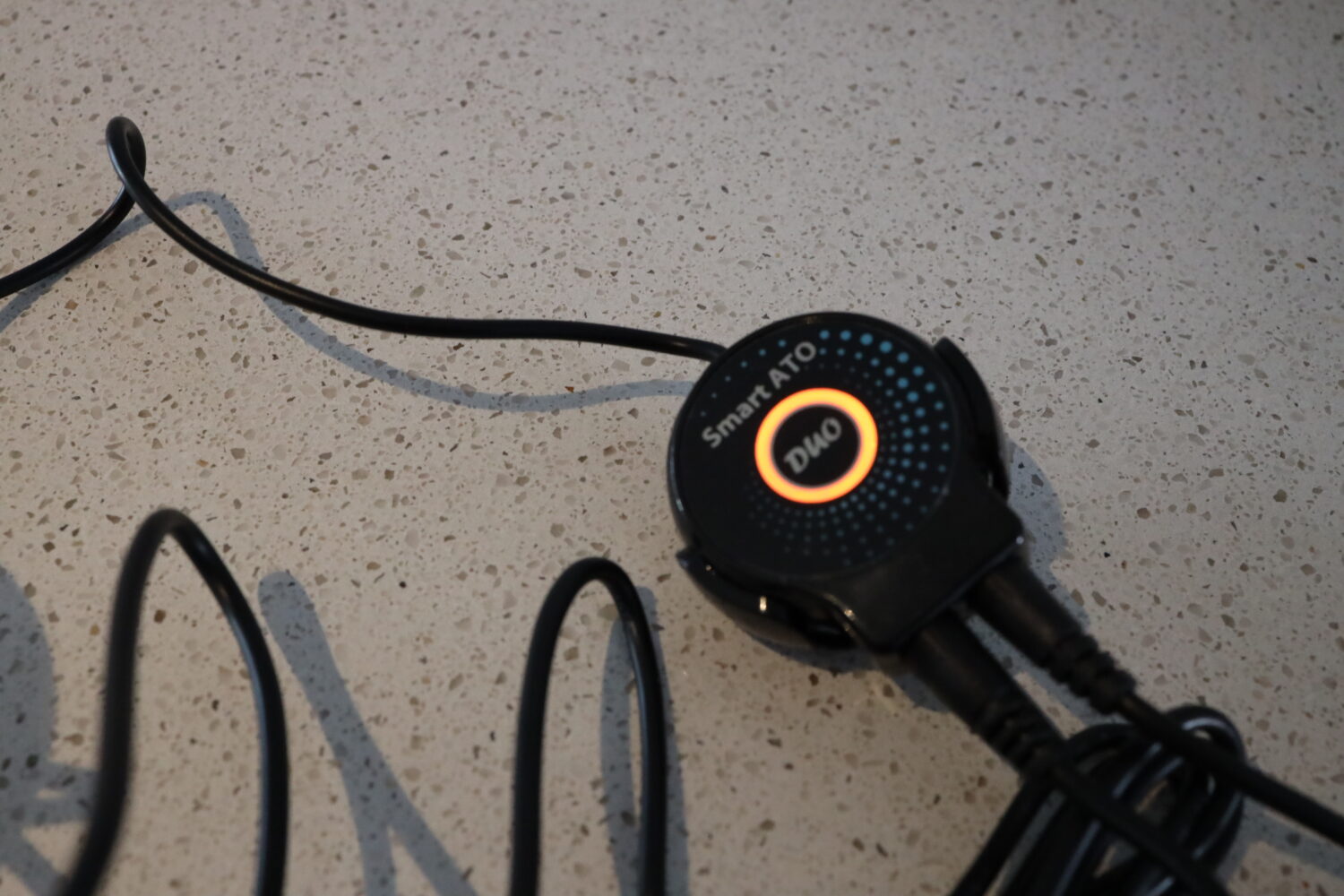
A notable feature is the safety mechanism that shuts off the pump when the ATO detects that the water reservoir is empty. This takes a little while, and is due to the fact that the ATO remembers how long it took to bring the water level up to the desired level when it was first turned on. AutoAqua multiplies that time by six to achieve the fail-safe mechanism that shuts off the pump when the osmosis chamber is empty. This is accompanied by a visual (orange light) and audible (on/off beep) alert.
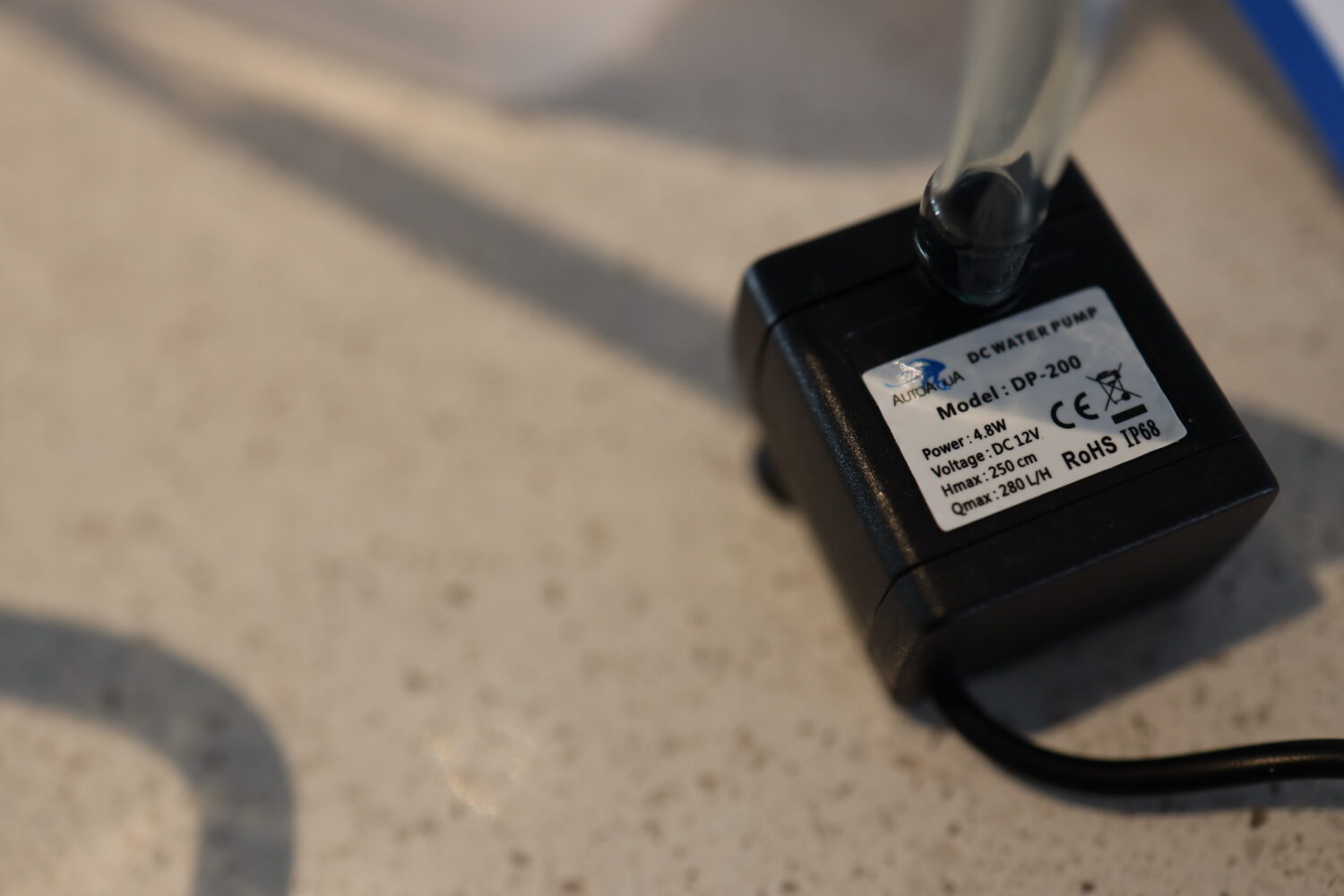
Finally, there’s the noise it makes. This is pretty much the main reason we’re considering switching from ATO. The Tunze osmolator may work exceptionally well, but we’re finding ourselves increasingly annoyed by the incredible noise that thing makes. The pump can still be heard a floor above, and the alarm causes instant irritation, forcing us to turn the whole thing off so we don’t go deaf. (To be fair, the audible alarm can be turned off on the Tunze ATO.) With the AutoAqua Smart ATO Duo, we don’t have this problem. The beep is softer in nature, without that shrill tone, and less loud. The 4.8-volt pump, which can pump 280 liters per hour, is also exceptionally quiet. It also has suction cups, making it easy to position—again, unlike the Tunze osmolator pump.
Decision
AutoAqua has managed to offer the same functionality—and more, such as an alarm that sounds if the tank hasn’t been topped off for 72 hours—as the Tunze ATO, but in a smaller, more modern, and, above all, quieter package. The AutoAqua Smart ATO Duo is exceptionally easy to use. Our tests give us enough confidence to install the device right away in our own aquarium.