Dr. Torben Krebs, head of the Panta Rhei laboratory, has a mission: to ensure that bacteriological testing becomes as commonplace as ICP testing already is. Reefkeepingtoday spoke with him about the Panta Germ test and the lab that makes it possible.
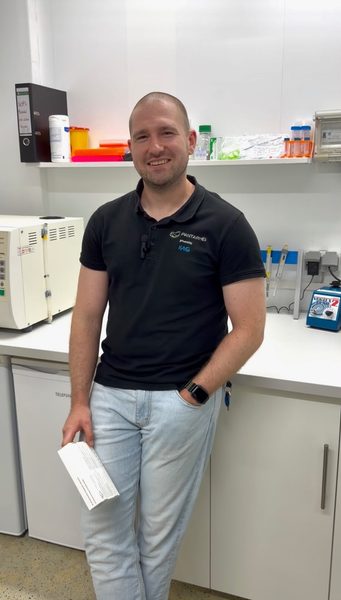
What is your background?
Torben Krebs: I hold a degree in Biology, having completed my undergraduate studies at the University of Göttingen, followed by my Master’s degree and doctoral studies at the University of Veterinary Medicine Hannover, where I focused on various aspects of fish diseases.
For the past one and a half years, I have been working at Kählig Antriebstechnik GmbH (KAG), the company behind the Panta Rhei brand.
How did the idea for the Panta Germ test come about?
Torben Krebs: The idea for the Panta Germ test began as a collaborative project at the university to develop this test kit. Many analyses in our hobby focus primarily on water chemistry. However, we saw a clear need for a test kit that specifically targets the biological aspect – the bacteria in the water.
Since the company was founded, we have had a physical-technical laboratory focused on areas such as X-ray analysis, product quality, and laser scanning. Since I joined the company, we have added a biological laboratory, where we perform molecular biological analysis.
Can you explain how the Panta Germ Test works? What exactly does it measure?
Torben Krebs: To obtain a representative picture of the bacterial community, a combination of water and biofilm samples is essential. Simply counting the total bacterial population is too superficial. Using DNA sequencing, we determine exactly which species of bacteria are present in the sample.
The results are based on species richness, bacterial diversity (Shannon and Simpson indices), and evenness, which describes how evenly bacteria are distributed within the community. The overall Panta Germ Score combines these indices to provide a comprehensive assessment of the bacterial community’s condition.
We also present the top 10 bacterial families, including the two most abundant genera within each family and the two most abundant species within each genus, along with their relative abundances. Additionally, we assess the bacterial community using the Panta Germ Balance Index. Another key focus is fish health. We identify potential primary pathogens, which can directly cause disease, and facultative pathogens, which may become pathogenic under unfavorable conditions, such as environmental stress or deteriorating water quality. We also screen for cyanobacteria.
What advice does an aquarium owner receive after a test?
Torben Krebs: Customers receive a detailed report. It includes recommendations on how to adjust the bacterial balance through water treatment. We do not yet offer exact dosages for any of the many bacterial mixtures available on the market, but that is something we may consider in the future. We do, however, provide technical suggestions: for example, increasing the flow rate can enhance bacterial diversity, or we may recommend a water change.
Every aquarium is unique. Since sea salt itself contains very few bacteria, most bacteria enter the aquarium through the live stock—which is why quarantine is so important. We recommend testing regularly: weekly at the start-up phase, then monthly, and eventually once every two months, so you can take proactive measures rather than reacting too late.
How does the Panta Germ test compare to traditional chemical ICP-OES tests?
Torben Krebs: They complement each other perfectly and, together, provide a complete picture of the aquarium. They are two completely different methods with different purposes: ICP focuses on the chemical aspect, while Panta Germ highlights the biological aspect.
As an aquarist, you need to take care of both.
What is your philosophy regarding the reef aquarium as a biological ecosystem?
Torben Krebs: Our philosophy is that “less is sometimes more”—think, for example, of less aggressive cleaning or less excessive use of UV lighting. Many aquarists are afraid of bacteria, even though the vast majority of them are actually extremely useful and indispensable. People often strive for ultra-pure water, but that’s not how nature works. Of course, no one wants a completely overgrown aquarium, but you do have to give the biological aspect a chance to thrive. The well-being of the animals always comes first, and maintaining a system that mimics nature as closely as possible is essential to that.
What are the biggest logistical and technical challenges involved in processing the Panta Germ test?
Torben Krebs: We’ve already processed a lot of tests. Logistically, everything is going very well; the test kits contain preservative buffers that ensure the samples remain stable during transport. However, bacterial sequencing is considerably more complex, labor-intensive, and expensive than chemical ICP tests. Currently, the turnaround time for a test is approximately four weeks, but we are working on reducing it. If you have an urgent problem, 4 weeks is too long. Our goal is to achieve a turnaround time of one week after the sample arrives. Exactly when this will be feasible depends on the test volumes, but we hope to achieve this in the first quarter of 2027.
What patterns do you see recurring in the samples analyzed?
Torben Krebs: Although every aquarium is unique, we see that specific bacteria reappear time and again under similar conditions. Natural seawater even contains specific bacterial “signatures” that reveal where the water comes from.
The amount of data we collect is enormous. We collaborate with research institutions and zoos to share this knowledge and plan to publish articles and case studies. In addition, we are gradually
working on using AI to analyze all this information internally and investigate how bacterial communities are affected by aquatic animals and technology.
What else can we expect from the Panta Rhei Lab in the future?
Torben Krebs: We are currently focusing on sequencing the bacterial community, but we want to expand this to include parasites, pathogens, and possibly fungi. This is currently in development. In the near future, we will launch a new version of our website featuring a comprehensive bacterial database, and we are exploring
the possibility of adding gamification elements. Ultimately, we view microbiological analysis as the most important tool for preventive care and continuous monitoring of fish and corals.
Thanks, Torben, for the interview!