
Reefkeepingtoday spoke with Dr. Tim Wijgerde, a researcher at Wageningen University and the director of the consulting firm Coral Publications. In this interview, he shows us his laboratory and explains his research. Among other things, his research focuses on how corals react to sunscreen.
What is your research question?
I am currently working as a researcher in the Marine Animal Ecology department at Wageningen University. We study a wide variety of animals, from plankton to cetaceans. Our main question is how marine animals respond to human-induced disturbances in the underwater environment, from the embryonic stage through to adulthood. Within this main question, there are many sub-questions, such as: “How do corals and sponges respond to climate change, ocean acidification, and pollution?”
We also conduct applied research. For example, with sponges, we’re investigating whether they can filter water contaminated by humans while also serving as a source of collagen. This collagen—a protein that’s important for wound healing—can then be used for medical applications.
Could you briefly explain your research to us?
One of my ongoing studies is examining how corals respond to UV filters in sunscreen. We believe that synthetic UV filters make corals more vulnerable to climate change. When seawater temperatures rise above 32 degrees Celsius in the summer, many corals expel their symbiotic algae (zooxanthellae), causing them to lose their color.
Corals cannot survive for long in this bleached state because they are no longer being nourished by their algae. When corals are exposed to both excessively warm water and UV filters, they appear to bleach and die more quickly. This means we need to look for natural UV filters that protect our skin from the sun without weakening the coral.
What is the context of this research—why exactly are you conducting this particular study?
For several years now, it has been clear that UV filters such as oxybenzone are harmful to corals. Recently, my colleague Diana Slijkerman of Wageningen Marine Research discovered that the coral reefs of Bonaire are exposed to fairly high doses of oxybenzone, originating from tourists who apply sunscreen. To better understand the potential adverse effects, we began this study last year. In this study, we are exposing the corals to the lowest concentration found in nature.
Even at a very low concentration of 1 ppb (microgram per liter of seawater), we see that corals such as Stylophora pistillata and Acropora prostrata are clearly affected by oxybenzone. At a low temperature of 26 degrees Celsius, everything seems fine, but when the temperature is gradually increased, it becomes clear that oxybenzone harms corals.
Have you achieved any (preliminary) results yet?
We now know that exposure to 1 ppb of oxybenzone results in 100% coral mortality when the water temperature is 32 degrees Celsius for a week. Without oxybenzone, only 40% die after a week at the same temperature. Such results suggest that hot summers can be even more harmful to coral reefs when they are exposed to pollutants such as sunscreen.
Our latest experiment will soon come to an end, and we will analyze the DNA of the corals weakened by oxybenzone. This should reveal whether oxybenzone harms corals by allowing harmful bacteria to multiply within them. This is because corals have an immune system in which bacteria play an important role, just as they do in humans.
What materials and equipment do you use for the study?
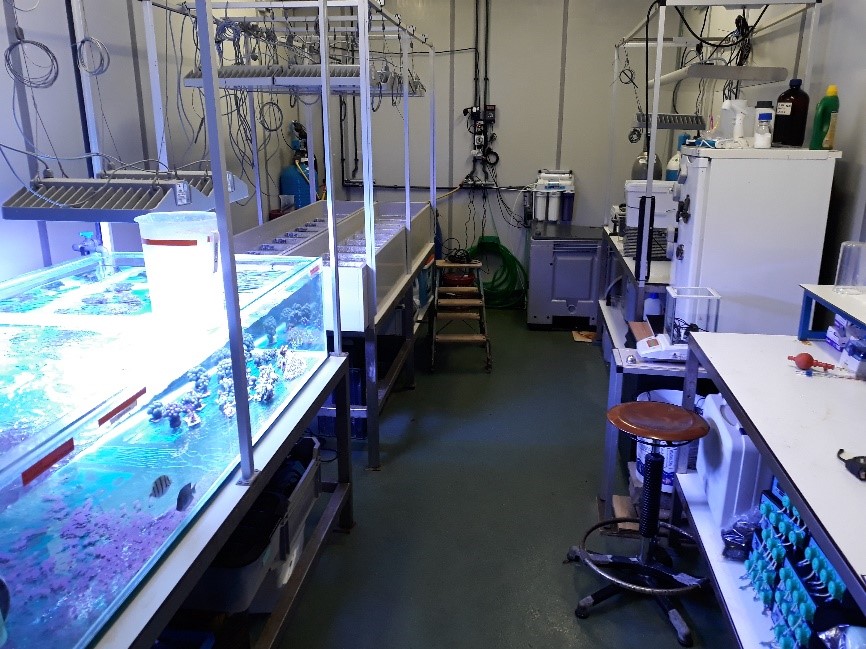
We use a wide variety of materials for our research, ranging from simple everyday objects to equipment costing a quarter of a million euros. For example, the fluorometer we use to measure the health of our corals costs about 27,000 euros. The most commonly used materials are aquariums and their accessories, such as flow pumps, lighting, and heating systems. We also have a large aquarium in which we cultivate coral for our research. In addition, our university has numerous laboratories for water analysis, DNA sequencing, and other complex measurement methods.
We follow a fairly rigorous methodology for our experiments. For example, for each selected culture condition, we use five independent aquariums, with multiple corals per aquarium. Each experiment is therefore repeated five times to test its reproducibility. Each aquarium is fed a constant flow of seawater, which is pumped from storage tanks using dosing pumps. By using small 12-liter aquariums, we can replace one-third of the aquarium water each day. This ensures highly stable water quality, allowing experiments to be conducted accurately.
We can also easily add substances such as oxybenzone using various containers. In addition, all the aquariums are placed in large water tanks to ensure that the temperature is uniform throughout. For example, we have one tank at 26 degrees Celsius and another that is gradually heated to 32 degrees.
Which coral is the focus of your research?
Our test species is Stylophora pistillata, but we are currently also working with Galaxea fascicularis, Acropora prostrata, and, more recently, Acropora tenuis. Max Janse, curator at Burgers’ Zoo, has donated a large specimen to us for research. I have also worked with countless species in the past, including both LPS and SPS corals, as they are known in the hobby.
Can your research be generalized to multiple species?
Because there are significant differences in how coral species—and certainly even within species—respond to their environment, we work with multiple species. For example, we’ve observed that Stylophora pistillata is very hardy, but this isn’t true for all individuals. In 2007, we received ten genetically distinct colonies of this species from the Gulf of Aqaba, Israel, all of which reacted differently in the aquarium under identical conditions. Some died within a few weeks, others barely grew, and a few grew very quickly. These individuals also all had slightly different colors, making them easy to tell apart.
In addition to the lab setting, does the research also include a fieldwork component?
This is often the case, though it varies by project. For the study on UV filters, my colleague Diana collected field samples from the reefs around Bonaire. The experiments are conducted in the lab. The sponge research is conducted almost entirely in the field, on the southern coast of Turkey. My colleagues also conduct fieldwork in the Netherlands (crabs, sponges), Norway and Canada (sponges), Curaçao and French Polynesia (corals and sponges), and Indonesia (corals, sponges, bivalves, and cetaceans).
What is the impact of your research?
The research we conduct at Marine Animal Ecology has implications for nature conservation and legislation, but also leads to new applications. Research on oxybenzone is already leading to policy changes; for example, the governments of Bonaire and Palau have banned the use of oxybenzone in sunscreen.
And what about the aquarium hobby?
The research described above has only limited relevance to the aquarium hobby, although I would caution hobbyists who use hand cream about potential adverse effects on the aquatic life in the aquarium. It is safer to apply various products to your hands after working in the aquarium. Activated charcoal, of course, could offer protection.
In our lab, we have recently made some discoveries that may be of interest to hobbyists. Like many hobbyists, we have observed that very low nitrate and phosphate levels lead to coral mortality—tissue necrosis. We can predict the death of, for example, Acropora spp. using a technique known as fluorescence measurement.
We do this using a fluorometer, which uses a strong light pulse to measure how effectively the zooxanthellae in the coral convert light into nutrients through photosynthesis. The healthier the algae in the coral, the more effectively they fluoresce light back to the sensor. A few days before the corals die from a lack of nutrients, we observe that the photosynthetic efficiency decreases from 70% (normal) to 40–50%. This suggests that coral mortality begins with the decline of the algae. When the algae die, they may poison the coral, resulting in necrosis. So, even though corals in nature live with very low nitrate and phosphate levels, deficiencies can still occur in an aquarium (with a lot of marine life and relatively little water).
Who is sponsoring the research?
Our projects are funded by NWO (the Netherlands Organization for Scientific Research), the European Union, and the university itself. We also regularly collaborate with companies, which sometimes provide funding or other resources.
How long will the research project take, and what stage are you at?
Many of our projects last three to four years. The coral and sponge projects are now in their second year.
How many researchers are working on the project?
This varies by project. Usually, three researchers work on a project, along with a few Ph.D. candidates and students.
Can hobbyists help advance your research?
That’s definitely possible! For example, last year I set up a home lab under my house, called CORALAB. Thanks to generous donations from hobbyists and companies, I was able to fund this lab in just a few months. Last year, I conducted a brief study in my lab on the effects of red and blue light on corals. The results of this study can be found in the latest issues of Ons zeeaquarium and Advanced Aquarist.
