
Is a coral not doing so well? Place the bleached coral next to—or better yet, against—a healthy coral. According to a new study, this approach can revive the diseased coral in just a few weeks.
Bleached corals are often considered a lost cause. However, previous research (Dutch article) has already shown that these corals should not be written off so quickly. And today, new research has been published that once again demonstrates that corals are more resilient than we often think.
Experiments conducted at Stanford University show that diseased corals benefit from direct contact with healthy ones. However, it is important that the corals involved are genetically identical. Through the “handshake” that takes place, the zooxanthellae can colonize the dead tissue more quickly.
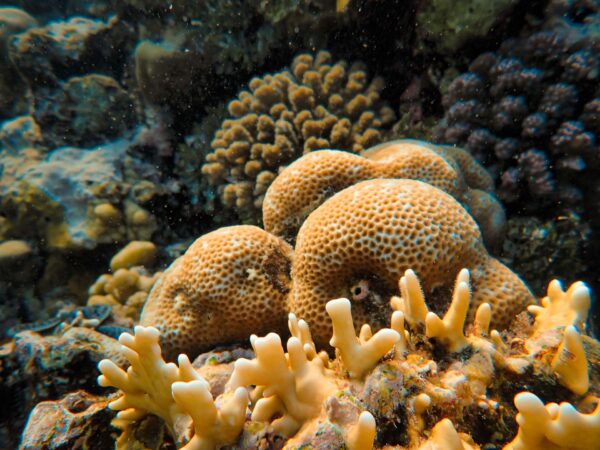
Danny Collins, the study’s lead author and a marine biologist at Stanford University, was surprised by how quickly corals can recover in this way. The discovery was also made by chance. In a lab aquarium, a piece of healthy coral tipped over, coming into contact with a bleached specimen. At that point, where the two corals touched, the diseased specimen regained its color.
The observation became a theory, and an experiment soon followed. Using ten pairs of cuttings—each consisting of one healthy and one bleached specimen—the theory was confirmed. The corals that touched each other became completely healthy in just seven weeks. The corals that did not touch each other fared relatively worse—several of them did not survive.
A helping hand
Under the microscope, it became clear how the process works. The corals form small bridges, creating channels that algae and nutrients can use. After just three days, these healthy “building blocks” were exchanged. Incidentally, corals don’t have to stay connected forever. After about one week of contact, the bleached corals can be separated and recover on their own at the same rate as coral pairs that remained attached to each other throughout the entire experiment.
This discovery has many interesting implications for us as hobbyists. A sick coral can be saved by placing it in contact with a healthy specimen. And a healthy specimen doesn’t have to be in the same aquarium at all. A few days of rehabilitation in a healthy tank can already make a big difference.
