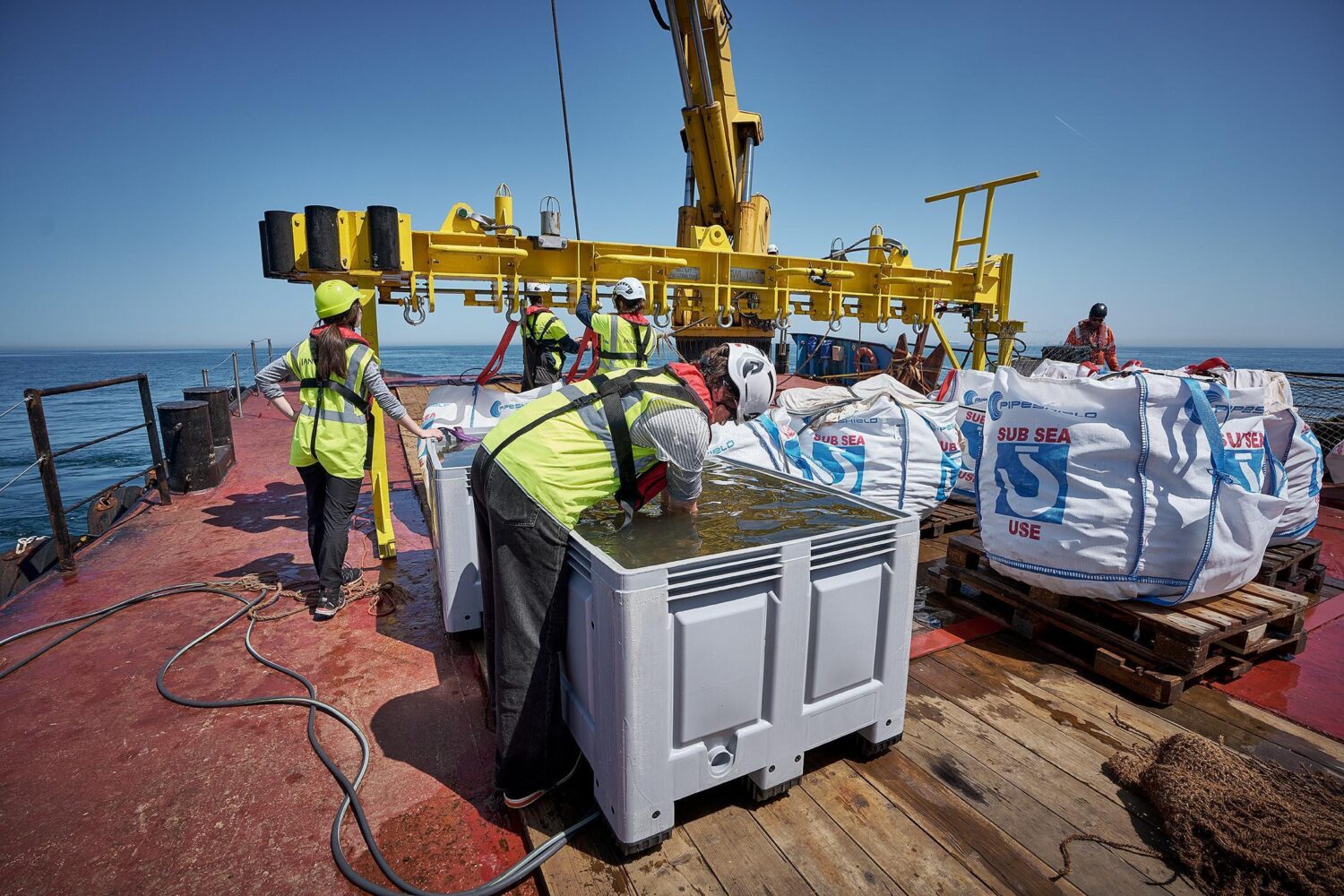
Since the beginning of this month, the seabed of the Belgian North Sea has been enriched with 2,000 stones and 400,000 young oysters. Jan De Nul carried out this initiative as part of the European research project Blue Connect. The project aims to learn more about marine habitat restoration.
400,000 oyster larvae were placed in the protected nature reserve surrounding the Dageraad shipwreck site. They are attached to 2,000 rocks. The oysters were cultivated in the oyster reef restoration unit, a modular facility made up of shipping containers that is mobile and capable of cultivating oysters worldwide.
The Dageraad shipwreck site is an area with historic gravel beds. The area offers ideal conditions for oysters, as sediment accumulation is limited due to the hydrodynamic conditions.
The goal now is to see how well the oysters are growing. Oyster beds are a natural refuge for our coastline and provide a home for a great deal of marine life. Of course, oyster beds are also economically important.
The pilot project is being carried out in collaboration with Ghent University, the Royal Belgian Institute of Natural Sciences, the Flemish Institute for the Sea, and the Federal Public Service for Public Health (Marine Environment Division). The project received support from the European Union.
